
A West Midlands 3rd Tier Automotive Pressing Plant
High-speed 3D robot vision for pressed aluminium parts

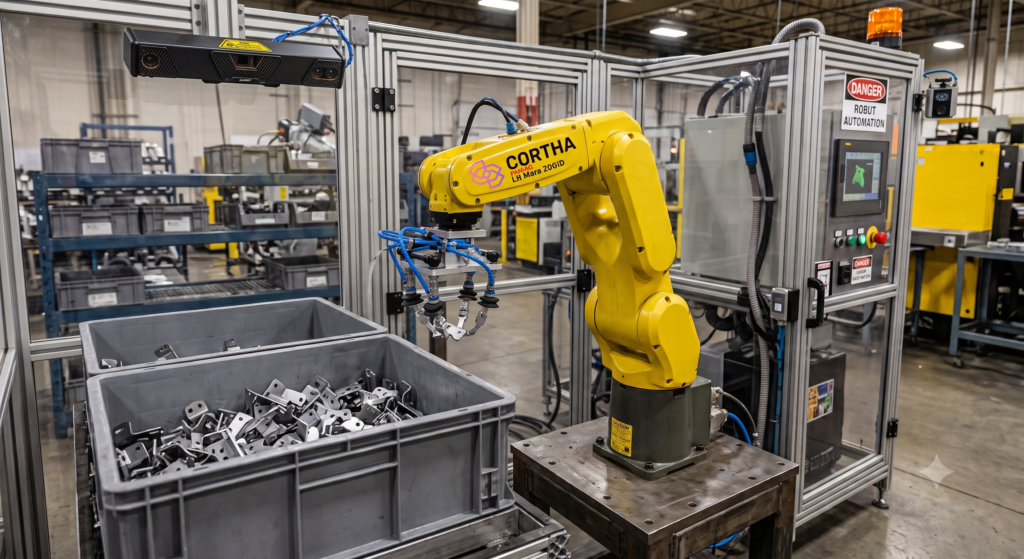
A long-term customer based in Walsall, West Midlands, who previously partnered with Cortha for surface defect inspection systems, faced a labour-intensive challenge in their pressing plant: manually picking pressed aluminium parts from tote bins. We developed an autonomous robot picking solution to streamline this process.
THE CHALLENGE
WHY THIS IS INTERESTING
Not that long ago, this type of application would have been significantly more problematic. Reliable 3D bin picking in variable ambient light was a major hurdle, often leading to inconsistent point cloud data and failed picks. Modern structured light cameras have overcome these limitations, providing robust performance even in unpredictable factory lighting, which allows for stable, high-speed automated picking that was previously difficult to achieve.
THE CUSTOMER’S PAIN POINT
Manual picking of pressed aluminium parts was slow and relied on two staff members over a 12-hour shift. The client needed to automate this to improve throughput and reallocate labour to higher-value tasks, while maintaining consistent production speed.
THE APPROACH
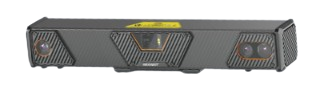
We integrated a robotic picking system using the RS Standard Series structured light stereo camera from Hikrobot. This system allows for high-precision 3D image acquisition in under 1 second, providing the robot with the spatial data required to accurately identify and grip parts from the bin using a custom end effector.
HOW WE BUILT IT
We deployed a high-speed robot cell equipped with a RoboScan 3D camera from Hikrobot. This camera captures precise 3D point cloud data in under one second, which is processed to detect the orientation of the aluminium parts.
The robot, equipped with a custom-designed gripper end effector, then executes the pick-and-place motion, ensuring a total cycle time of 1500 milliseconds.
This setup integrates seamlessly with existing plant infrastructure, leveraging the reliability and speed of the stereo imaging technology.
RESULTS
| MEASURE | BEFORE | AFTER |
|---|---|---|
| Pick Reliability | n/a | 99.7% |
| Cycle Time Per Item | Variable | 0.6s |
| Misplaced/Dropped Items | Human nature | 0.3% |
- Cycle Time: The total cycle time per pick is now 1500 milliseconds.
- Labour Efficiency: The system has successfully enabled the customer to reallocate two people over every 12-hour shift.
- Return on Investment: The efficiency gains have resulted in a full return on investment within 18 months.
WHY THIS IS GOOD
The latest generation of 3D cameras designed for robot vision simplify these kinds of robot vision applications. There are many brands of cameras offering 3D capability all with different strengths and weaknesses, so there are many to choose from.
Our team has been installing 3D robot vision for over a decade. In fact there are not many with this longevity in the industry. We have worked with ‘home made’ stereo cameras, which can be notoriously difficult to set up and maintain, requiring complicated and heavy external calibration devices to get the required 3D calibrations. Fortunately, all that has changed and we have a wealth of professional cameras to choose from. We’ve done the hard work and tried many of them, we know what’s good.
Remove the risk. Don’t rely on old and outdated DIY technology.
Ask us about random 3D robot bin picking.
