
Inspection and Automation for the Commercial Fishing Industry
Onboard Shellfish Machine Vision
Inspection System

Traditional bottom trawling and manual handling are labour-intensive, subjective, and prone to quality degradation. By automating onboard quality control and sorting, this system transforms raw catch into high-value, fully traceable seafood while enhancing fishery sustainability.
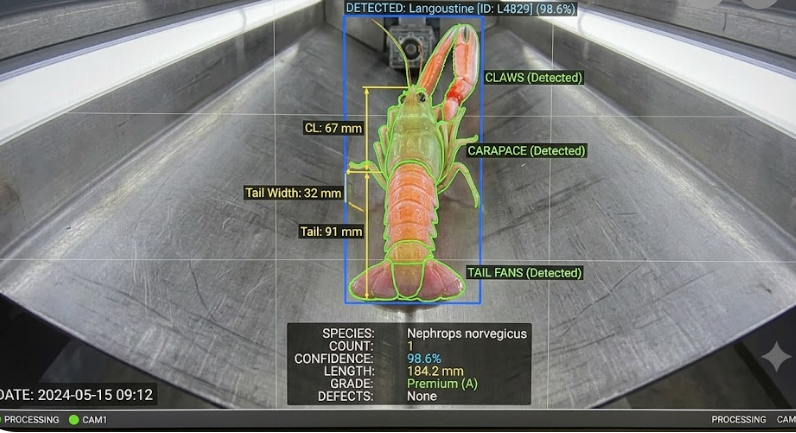
The core objective of this machine vision system is to inspect each prawn immediately upon landing, performing high-speed morphometric analysis, sex determination, conservation sorting, physical stress evaluation, and real-time geotagged telemetry uplink to the Cortha Dashboard platform.
Onboard System Architecture & Optical Inspection Cell
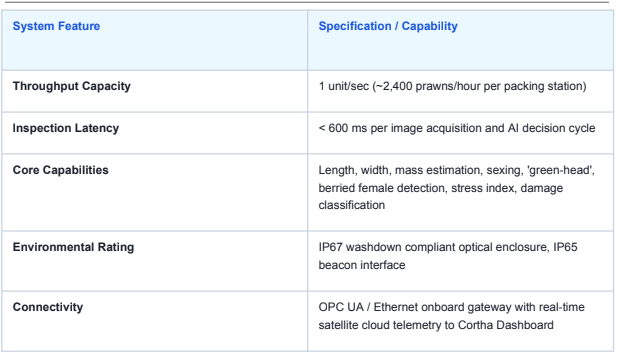
The inspection hardware is integrated into a compact, marine-grade workstation positioned directly along the vessel’s primary handling line. Prawns are singulated via a hopper feed or inclined conveyor to pass beneath the optical array at a speed of 1 unit per second (up to 2,400 units/hour per station) with a target inspection latency of 600–1000 ms per prawn.
Key Hardware Components:
- Primary Camera: IP67-rated industrial RGB camera featuring a high-resolution sensor and waterproof M12 connectors
- Dual-Camera Configuration Option: Optional bottom-up camera imaging cell combined with top-down capture to eliminate occlusions and accurately evaluate ventral anatomy.
- Illumination: High-intensity linear LED light bars with calibrated diffusion to prevent specular glare on wet carapaces.
- Operator Interface & Actuation: 4-light IP65 beacon interface (traffic light feedback) for manual packing assistance and automated pneumatic divert gates for sorting.
- Computing: High performance vision server with GPU
- AI Software: Cortha AI software running custom vision and neural network pipelines.
THE TASK
Automated Sorting, Morphometrics & Gender Identification
Each prawn passing through the imaging zone is segmented and analyzed in real time across several crucial biological and physical metrics:
Morphometrics & Mass Estimation
- Length & Width Measurement: Accurate millimetre-level dimensional profiling of carapace and tail length.
- Volumetric Mass Calculation: Volumetric reconstruction via 3D imaging combined with density algorithms (Mass = Density x Volume) to estimate individual and cumulative packed weights without physical touch.
- Physical Damage Detection: Neural network classification identifying missing claws/limbs, crushed carapaces, or shell cracks.
Gender Determination & Conservation Actions
- Sex Identification: Morphological discrimination between male and female specimens based on ventral pleopod structures and body proportions.
- ‘Green-Head’ Detection: Optical colour classification identifying mature females in the reproductive phase, where ripening ovaries exhibit a dark green colour visible through the thorax wall.
- Berried Female Detection & Automated Sea Return: High-confidence detection of egg-bearing (‘berried’) females carrying dark green or orange egg masses under the abdomen. Detected berried females trigger an immediate pneumatic reject mechanism that safely returns them to the sea via a gentle water slide, maintaining breeding stocks and meeting strict environmental conservation mandates.
Real-Time Capture & Handling Stress Monitoring
Trawling, net compression, and haul-back exposure induce severe metabolic, physiological, and physical stress in crustaceans. Under severe capture stress, langoustines show distinct physical and biochemical markers that directly impact post-capture survival, muscle degradation, and market value. The vision system incorporates dedicated multi-spectral and optical classifiers to measure stress indicators in real time:
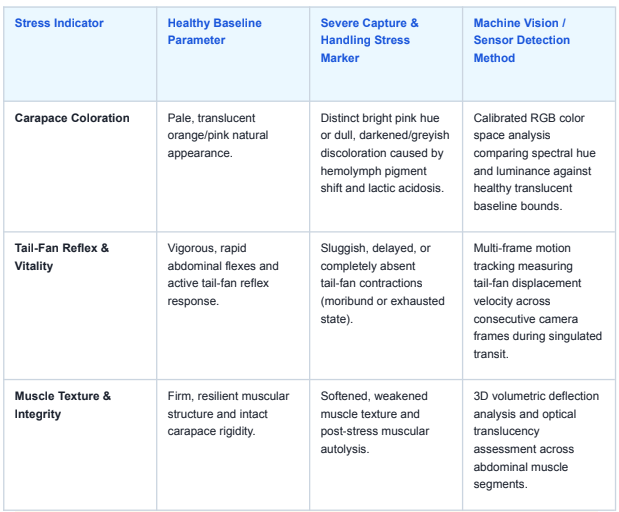
Quality Impact: Prawns showing severe stress markers are automatically downgraded from Grade Extra/A (live transport / high-value whole market) to Grade B or diverted to immediate tailing/frozen processing, protecting premium box quality and preventing product degradation in live holding tanks.
Geotagging, Cortha Dashboard Integration & Real-Time Telemetry
Data harvested at the vessel’s inspection gateway is combined with spatial, environmental, and operational telemetry to create a complete, tamper-proof record of every fishing haul.
Onboard Data Management Gateway
The onboard Gateway aggregates real-time data channels including:
- Vision & Grading Metrics: Count, gender ratio, size distribution, mass estimate, berried return count, defect score, and stress index.
- GPS & Spatiotemporal Data: Exact geotagged latitude/longitude, haul time, tow duration, speed, and water depth.
- Environmental Conditions: Sea surface temperature, salinity, and tide phase.
Cloud Synchronisation & Cortha Dashboard Platform
Data is transmitted via satellite/cellular up-link to the cloud-based Cortha Dashboard (built on Google Cloud Platform). The platform provides tailored, real-time access interfaces for three primary user groups:
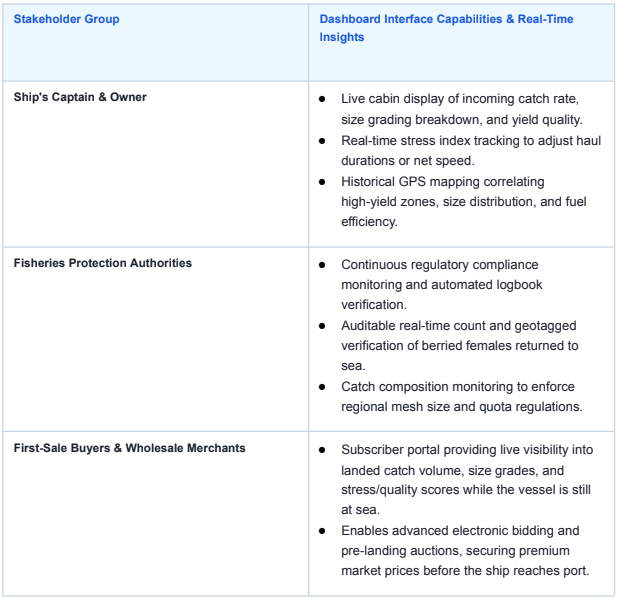
Commercial Integration: The Cortha Dashboard connects via APIs to online seafood market platforms (such as the European Fish Price Report or Mercamadrid APIs) to match real-time onboard catch profiles directly with live market demand.
Do YOU have a very challenging inspection requirement?
Please speak to us, we may be able to help.
