
Quantitative Structural Profiling for High-Speed Food Inspection
Measurement and Analyses of the Biological Form
Morphometric analysis is the quantitative measurement and structural evaluation of biological forms, dimensional geometry, volume, and surface features. Unlike manufactured industrial parts—which conform to strict CAD templates—raw food items such as seafood, meat cuts, and produce exhibit continuous natural variation in shape, weight, colour, and tissue composition.
In modern industrial food processing, machine vision systems augmented by 3D optical profiling and artificial intelligence (AI) elevate traditional 2D image inspection into full morphometric analysis. By capturing accurate volumetric, geometric, and tissue data in real time, vision systems enable precise quality grading, non-contact weight estimation, defect identification, and automated sorting.

How Machine Vision Analyses Shape and Content
Standard 2D RGB cameras inspect surface colours and 2D footprints, but struggle with depth, volumetric mass, structural inclination, or complex internal composition. Advanced morphometric vision engines pair multi-dimensional imaging with deep learning pipelines:
- 3D Surface Profiling & Triangulation: Laser line scanners and structured light sensors capture sub-millimetre depth profiles, mapping the 3D surface topography of raw food items.
- Volumetric Mass Reconstruction: By combining width, length, and depth measurements, vision systems execute mathematical volumetric algorithms to calculate unit weight dynamically without physical touch.
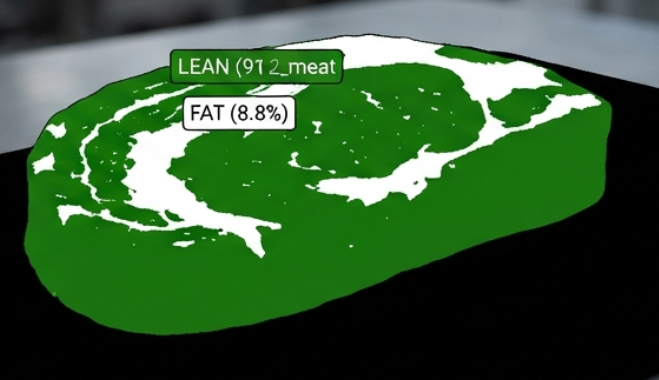
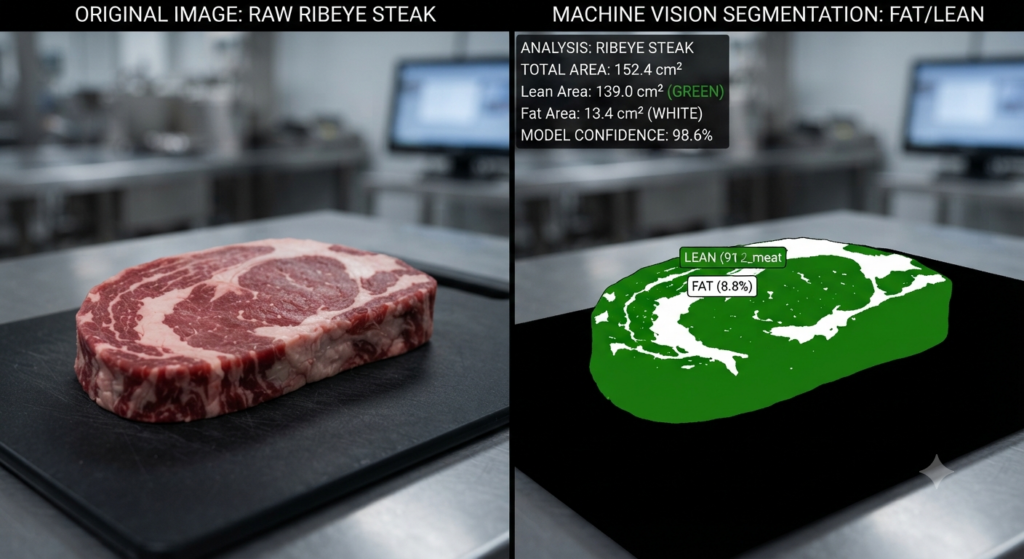
- Spectral & Colour Segmentation: Calibrated colour spaces discriminate between different tissue types (e.g., lean muscle vs. subcutaneous fat, translucent carapace vs. dark egg masses) based on optical wavelengths.
- Deep Learning Defect & Anatomy Classification: Convolutional Neural Networks (CNNs) evaluate spatial patterns to identify anatomical landmarks (such as pleopods or claws) and structural defects (cracks, missing limbs, or surface tears).
Broad Applications Across the Food Sector
Morphometric analysis provides a versatile framework across diverse food processing sectors where product geometry and natural variation directly impact quality and profitability. Key application areas include:
- Volumetric Sorting & Grading: Automated sorting of fruits, vegetables, and poultry portions by volume and target dimensions ensures uniform packaging and accurate grade assignment.
- Bakery Dimensional Consistency: Continuous 3D monitoring of dough products, breads, and baked goods verifies thickness, height profiles, and shape uniformity before packaging.
- Real-Time Defect & Deformity Detection: Deep learning models instantly identify morphological anomalies, structural damage, surface tears, or misshapen items on high-speed processing lines.
- Non-Contact Mass Estimation: Volumetric algorithms calculate real-time weight estimates without physical contact, improving yield optimisation and reducing giveaway across irregular food items.
Key Benefits for Food Producers
Implementing automated morphometric analysis delivers tangible operational advantages and financial returns across high-speed processing environments:
- High-Value Product Quality Assurance: In sectors like meat inspection—where products carry high intrinsic value and customer expectations regarding cut consistency, fat-to-lean ratios, and grade are exceptionally stringent—morphometric profiling ensures precise, objective quality assurance on every unit.
- Preventing Complaints & Batch Rejections: By detecting off-spec products, dimensional deformities, and defects in real time, the system prevents downstream customer complaints, costly chargebacks, and full batch rejections.
- Automated Inline Decision-Making: The system eliminates the need for constant manual measurement by making intelligent, highly reliable sorting decisions inline. Non-conforming items are automatically ejected or rerouted for secondary human review, targeting manual inspection only where needed.
- Higher Quality, Lower Operating Costs & Rapid ROI: Producers achieve consistently superior product quality alongside reduced labour overheads. Because these vision systems can be easily retrofitted into existing production lines without major structural overhauls, facilities realise a rapid return on investment.
Summary
Cortha’s Morphometric Analysis Vision System brings standardised, objective quality control to naturally variable raw products. By integrating high-resolution 3D profiling, deep learning image classification, and high-speed processing, modern machine vision enables food producers to maximise yields, protect premium product grades, and reduce manual processing overheads.
