
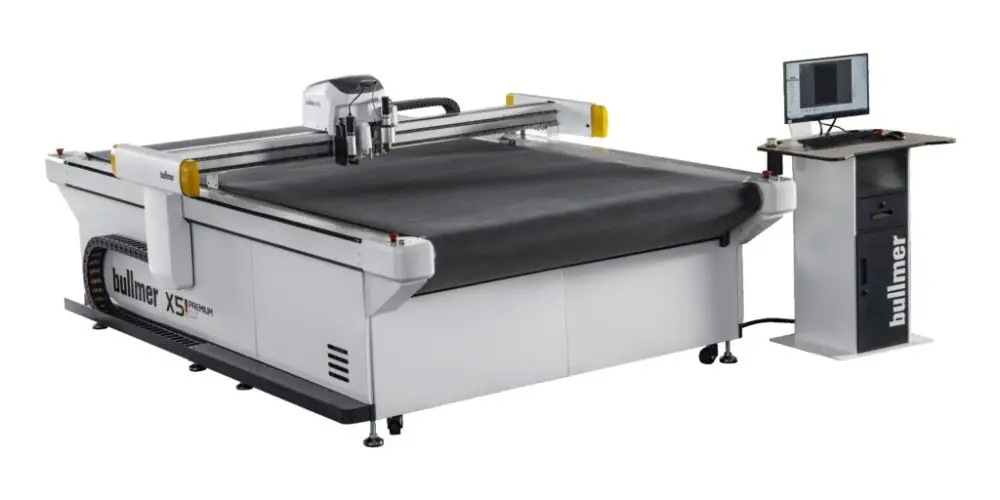
An inspection system for an aerospace customer
The Cortha CFIS: A Multisensor Web Inspection System

Our customer was required to deliver continuous, non-destructive inline defect detection for unidirectional prepreg and carbon fibre rolls prior to cutting, significantly reducing material scrap and manual inspection effort. A key performance target was 98% probability of detection on critical defects with a false positive rate of under 5%.
The Customer’s Pain Point
Carbon fibre pre-preg (carbon fibre pre-impregnated with a resin system like epoxy) is a high-value, premium raw material. Its commercial value varies based on fibre grade, resin system, structural weave, and certification standards.
Because pre-preg is a costly raw material, scrap directly severely impacts margins:
-
High Cost per Roll: A standard 50-metre roll of prepreg web (e.g., 1.4 m to 2.6 m wide) easily represents a raw material value of £3,000 to £10,000+ per roll.
-
Cold-Storage & Shelf-Life Constraints: Prepregs require temperature-controlled cold storage (typically stored at -18 degrees Celsius). Once thawed for processing on the cutting table, the material’s out-life timer begins, making wasted, mis-cut, or scrapped material doubly expensive.
-
Compounded Value Loss Post-Cut: If an undetected defect (such as a missing stitch, resin spot, or broken tow) passes through the flatbed cutter into curing (autoclave/press), the loss isn’t just the raw material—it includes lost machine time, labour, and the high energy costs of curing.
THE CHALLENGE
WHY THIS IS HARD
Inspecting carbon fibre prepregs and woven rolls presents unique optical and technical hurdles that traditional machine vision systems struggle to overcome:
- Low Optical Contrast (“Black-on-Black”): Carbon fibre filaments and stitching are inherently dark black, absorbing the vast majority of visible light. Identifying subtle defects—such as missing black stitches, subtle fibre misalignment, or dark resin accumulation—on a black material web creates an extreme low-contrast scenario.
- Specular Reflections: Carbon fibre and its uncured resin matrices are highly reflective and glossy. Direct lighting often causes severe specular glare that masks small surface defects (e.g., powder flecks or small resin spots) or creates false positive reflections.
- Defect Variety & Micro-Scale Requirements: Defects range from sub-millimetre surface anomalies (e.g., 0.75 mm–1.0 mm powder flecks and resin spots) to broad structural or elevation issues.
- High-Speed Continuous Production: Carbon fibre rolls feed off a roll onto flatbed cutting tables at moving speeds of up to 5 metres per minute across web widths ranging from 1,400 mm to 2,600 mm. Inspection must occur inline in real time without causing line stoppages.
SOLVING THE IMAGE ACQUISITION PROBLEM
To address these challenges, the Cortha team designed a multi-sensor approach combining different optical and physical measurement principles:
A. 2D Area-Scan Cameras (Monochrome & Colour)
- How It Works: Captures a standard rectangular grid (frame) of pixels at once using a two-dimensional matrix sensor.
-
Role & Strengths: Area-scan cameras work effectively for high-contrast or distinct surface anomalies, such as brown cardboard Foreign Object Debris (FOD), paper splices, or edge alignment issues where colour or gross boundary contrast is visible.
- Limitations: Over wide webs (up to 2.6 m), maintaining sub-millimetre resolution requires a large array of cameras. They struggle significantly with low-contrast “black-on-black” defects and subtle 3D surface elevation changes.
B. Linescan Cameras & Contact Image Sensors (CIS)
-
How It Works: Linescan cameras read the web line-by-line (e.g., 2K pixel lines) synchronised precisely to material movement using a conveyor encoder trigger. Contact Image Sensors integrate the sensor row, gradient-index lenses, and LED lighting into a single compact housing placed very close to the web (e.g., 13.9 mm working distance, delivering ~35 pixels/mm resolution).
-
Role & Strengths: Linescan technology provides continuous, seamless, high-resolution imaging across moving webs without spatial distortion or frame-stitching boundaries. CIS units excel at capturing micro-surface defects, narrow gaps, uncured resin accumulations, and specular powder spots.
C. Polarisation Sensors
-
How It Works: Polarised cameras incorporate a four-directional polariser array directly onto the sensor pixels. By capturing light intensity at four angles simultaneously, the camera calculates the direction and Degree of Polarisation (DoP).
-
Role & Strengths: Because carbon fibre filaments naturally act as a polarising grid, the sensor measures the physical angle of the individual fibres. Instead of a standard RGB image, it generates a “heat map” representing fibre layout angles. This allows the system to detect fibre orientation, weave distortion, tow misalignment, and black-on-black stitching flaws that are completely invisible to standard human vision or conventional cameras.
D. 3D Laser-Line Profilers (Triangulation)
-
How It Works: A focusable laser emitter projects a sheet/line of laser light onto the moving carbon fibre sheet. An angled 3D streaming camera uses Rapid On-Chip Calculation (ROCC) to measure the vertical deviation of the laser line, reconstructing a 3D point cloud of the material surface.
-
Role & Strengths: Because height calculation depends purely on laser geometry, this technology is completely immune to surface colour, dark material absorption, or optical contrast. It provides pseudo-coloured height maps that effortlessly highlight 3D topological defects such as wrinkles, folds, puckers, pimples, broken tows, and elevated foreign object debris.

ANALYSING THE IMAGES USING AI
Traditional rule-based computer vision algorithms struggle with carbon fibre due to the high variability of the woven texture and complex material patterns. Artificial Neural Networks (ANNs) and Convolutional Neural Networks (CNNs) provide the classification intelligence needed for automated inspection.
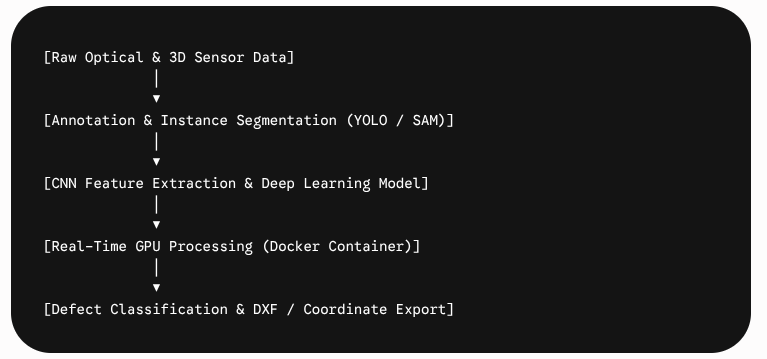
A. Data Acquisition & Annotation Strategy
To train a deep learning model, raw high-resolution linescan images, polarisation angle maps, and 3D point clouds are combined into a centralised training database. Using instance segmentation models in the Cortha AI inspection platform, defect regions are annotated. Instead of broad bounding boxes, precise polygon boundaries are drawn around defects (e.g., resin spots, wrinkles, broken tows, and FOD) to preserve exact spatial dimensions.
B. Convolutional Neural Network (CNN) Training
Transfer Learning: Training deep neural networks from scratch requires tens of thousands of images. The Cortha CFIS training pipeline expedites transfer learning by using pre-trained feature weights and fine-tuning the model on specialised carbon fibre defect samples.
Feature Learning: CNNs pass image layers through convolutional filters that automatically learn complex spatial features—ranging from low-level edge contrasts to high-level structural patterns like stitch irregularity or fibre angle deviations.
C. Real-Time Inference & Deployment Architecture
Containerised Edge Deployment: Trained neural models are packaged inside Docker containers, isolating the neural network environment from underlying system OS variances and enabling reliable edge execution.
Hardware Acceleration: The processing tier utilises industrial PCs equipped with dedicated GPUs to execute model inference in milliseconds as the carbon fibre moves at line speed.
Actionable Output: Once a defect is detected and classified, the deep learning pipeline outputs precise X/Y coordinates (start position, end position, and bounding size). This data is logged to a database and exported as DXF defect maps , enabling automated cutting tables (e.g., Assyst Bulmer flatbed cutters) to automatically route cut patterns around flawed material zones.
THE RESULTS
This development provides both productivity and labour savings for the manufacturer. Previously, inspection was a manual process relying on the ability of the inspector to observe the complete process as it happens. Additionally, if defects were observed, the process by which this was recorded meant that some time passed before the production was stopped and the defect removed.
Complete sections of the web were removed before and after the defect location, meaning there was significant wastage.
IN SUMMARY
Implementing the Cortha Automated Web Inspection System delivers critical commercial, financial and operational advantages to manufacturers and end-users working with high-value composite materials:
Material Scrap & Cost Reduction
- Preventing Waste Before Cutting: Inspecting carbon fibre rolls inline prior to cutting allows flatbed cutting machines to automatically re-route cut patterns (nesting) around flawed material zones.
-
High Yield Optimization: Uncured prepreg and woven carbon fibre are exceptionally expensive raw materials; eliminating bad cuts significantly reduces overall scrap rates and material unit costs.
Superior Quality Control & Risk Mitigation
- 98%+ Probability of Detection (PoD): The multi-sensor optical system reliably captures sub-millimetre flaws (0.75 mm – 1.0 mm) and dark-on-dark surface/structural defects
- Low False-Positive Rates (< 5%): Minimizes unnecessary production line halts or erroneous scrap rejection, keeping line throughput consistent.
- Auditability & Traceability: Detailed defect mapping (recording precise $X/Y$ start and end coordinates) provides traceable compliance records required by high-spec industries like aerospace, automotive, and defence.
Productivity & Labour Savings
- Elimination of Manual Inspection: Replaces visual human inspection, which is slow, subjective, and prone to fatigue, with continuous, automated non-destructive testing (NDT).
- Uninterrupted Production Takt Time: Operates directly on moving material at continuous production line speeds of up to 5 metres per minute.
Operational Scalability & Integration
-
Modular OEM & Retrofit Value: Assyst Bulmer can offer the system as an integrated OEM add-on for new flatbed cutters or as a standardised retrofit package for existing production lines.
-
Rugged & Low Maintenance: Features IP54 dust-resistant electrical enclosures to safely operate in carbon-dust environments, lowering long-term maintenance overhead.
Do YOU have a very challenging inspection requirement?
Please speak to us, we may be able to help.
