
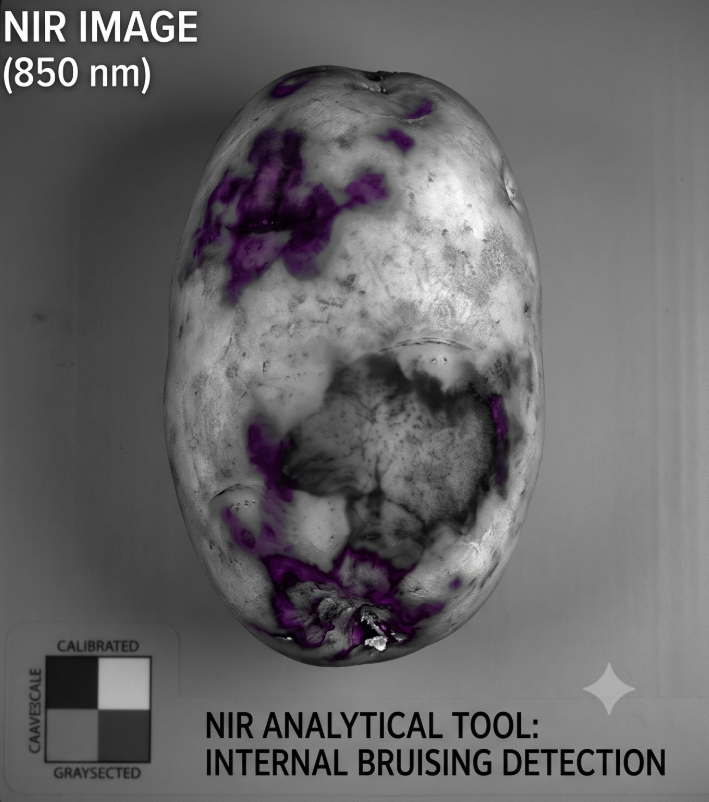
Using advanced imaging technology to see ‘inside’ fresh produce will help the global fresh produce industry
Multispectral and Hyperspectral Imaging for Invisible Defect Detection

The global fresh produce industry faces increasingly stringent international phytosanitary standards and strict export quality benchmarks. In highly demanding export regions like the US, EU, and UK, the presence of subsurface insect damage or microscopic egg masses can lead to severe commercial penalties, container destruction, or temporary packing facility shutdowns. Traditional visual inspection relies heavily on manual labour, which introduces high human variability, operational bottlenecks, and an inherent inability to detect early-stage internal anomalies at high line speeds.
To overcome these limitations, advanced optical sorting systems leveraging multispectral and hyperspectral imaging are shifting inspection from a subjective art to a precise, non-destructive automated science.
Core Terminology and Technological Distinctions: NIR, Multispectral, and Hyperspectral
Understanding the distinct roles of Near-Infrared (NIR), multi-spectral, and hyper-spectral technologies requires looking at how they capture and process the electromagnetic spectrum.
[ NIR Technology ] ───> Targets a specific wavelength band (750–2500 nm) focused on moisture & organic bounds.
[ Multi-spectral ] ───> Captures discrete, non-contiguous bands (typically 3 to 10 discrete channels).
[ Hyper-spectral ] ───> Measures continuous, unbroken spectral data across hundreds of contiguous narrow bands.
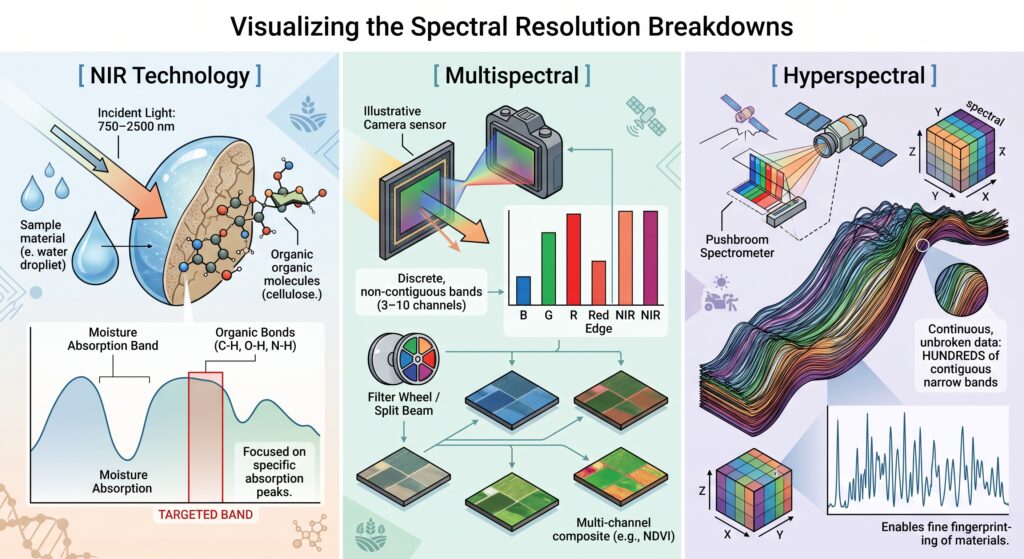
- Near-Infrared (NIR) Technology: NIR refers to a specific portion of the electromagnetic spectrum, generally ranging from 750 nm to 2500 nm. Rather than denoting a specific camera architecture, NIR represents a critical wavelength band where biological tissue exhibits distinct light scattering and absorption properties. In agricultural contexts, NIR is highly sensitive to moisture content, cellular density, and organic compounds, making it ideal for detecting subsurface structural changes.
- Multispectral Imaging: Multispectral systems capture light across a small number of discrete, non-contiguous spectral bands—typically between 3 and 10 channels. For example, a multispectral camera might capture standard Red, Green, and Blue (RGB) wavelengths alongside one or two specific infrared bands optimized to detect a single target, such as a localized surface pigment or chitin signature. This approach delivers targeted data with low computational overhead, allowing for rapid real-time sorting.
- Hyperspectral Imaging (HSI): Hyperspectral systems collect continuous, unbroken spectral information across hundreds of narrow, contiguous bands. Instead of looking at individual color channels, HSI generates a comprehensive “spectral fingerprint” for every single pixel in an image. This creates a massive data structure known as a “hypercube” (containing two spatial dimensions and one spectral dimension). HSI provides the extreme diagnostic resolution required to distinguish minute biochemical changes in plant tissue before visible external indicators develop.
Camera Architectures Available in the Industrial Market
1. Push-broom (Line-Scan) Systems
Line-scan cameras capture a single narrow spatial line across hundreds of spectral channels simultaneously. The complete 3D hypercube is progressively built frame-by-frame as either the product moves past the camera on a conveyor belt or the camera translates across a static field.
- Industrial Alignment: Highly optimised for continuous linear factory sorting and high-speed conveyor configurations.
Prominent Hardware Offerings:
- Specim (FX Series): Renowned for rigorous factory sorting applications, offering exceptional industrial reliability and optimised high-speed line integration.
- Resonon (Pika XC2 / Pika L): Celebrated for highly accurate scientific research, environmental data gathering, and unmanned aerial vehicle (UAV) deployment.
2. Snapshot (Light-Field) Systems
Snapshot cameras capture the entire spatial and spectral dataset (X, Y, and λ) during a single exposure sequence at video frame rates (up to 30 frames per second). It eliminates the need for relative mechanical movement or strict conveyor synchronisation by leveraging specialised multiplexed light-field optics and hardware-accelerated reconstruction algorithms.
- Industrial Alignment: Ideal for real-time, non-linear machine vision applications where products may rotate or sit static on an active test bench.
Prominent Hardware Offerings:
- Living Optics (SpectralCamera): A pioneering snapshot solution delivering instantaneous full-frame 2D hyperspectral data capture without mechanical scanning hardware.
Operational Hurdles and Future Horizons
Deploying high-resolution optical inspection into food processing environments introduces distinct environmental challenges. Freshly washed vegetables carry surface water, which creates specular reflections and alters the refractive index of the plant cuticle, potentially masking subtle spectral signatures. To counteract this, modern grading lines integrate air-knife drying systems directly ahead of the imaging tunnel to stabilise the product’s surface prior to scanning.
Furthermore, forward-thinking operators are looking to extend these capabilities further upstream. By mounting lightweight multi-spectral snapshot sensors onto mobile field scanners or agricultural drones, agribusinesses can detect crop infestations before harvest, enabling targeted field interventions and significantly reducing raw material losses before the crop ever reaches the processing facility.
Case Study: Integrating Thermal Inspection
The Cortha Team added a Long-Wave Infrared (LWIR) thermal camera to a traditional RGB optical root vegetable sorter to upgrade quality control from surface-level inspection to full-structural volumetric analysis. While conventional RGB cameras are limited to visible skin defects, thermal cameras detect internal physiological flaws without slowing down the processing line.
Visible vs. Thermal Inspection Capabilities
| Inspection Dimension | RGB Optical Sorter Only | RGB + Thermal Camera Sorter |
| Surface Greening & Rot | High Detection (>95%) | High Detection (>95%) |
| Mechanical Skinning | High Detection | High Detection |
| Hollow Heart Cavities | Undetectable (0%) | High Detection (85-90%) |
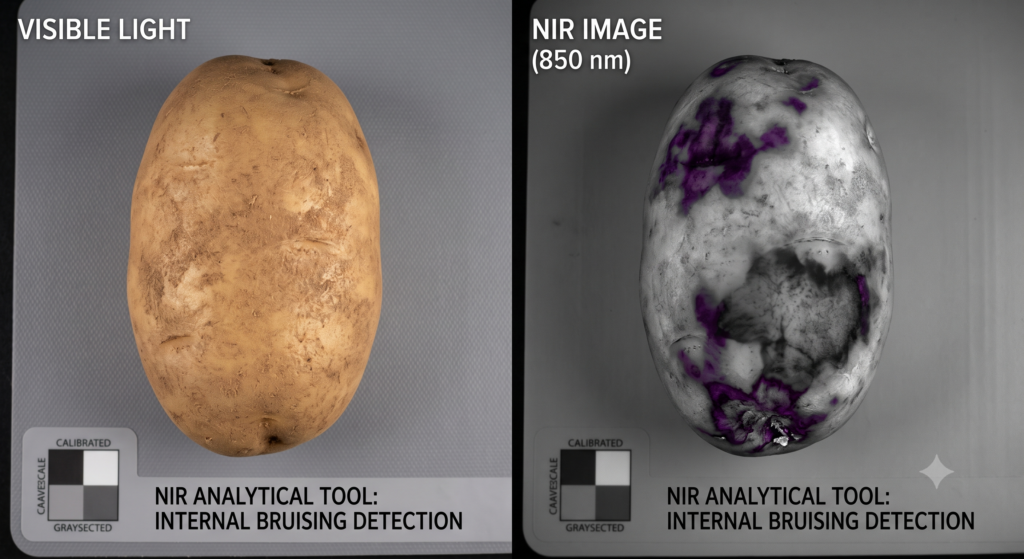
| Internal Blackspot Bruising | Undetectable (0%) | High Detection (90%+) |
| Deep Frost Damage | Missed until rot sets in | Detected immediately via tissue density shifts |
Core Quality Control Impacts
-
Elimination of “Hidden” Rejects: Internal defects like hollow heart act as thermal insulators. When potatoes pass under a quick heat pulse, internal air pockets block heat dissipation, creating a surface hot spot that thermal sensors flag instantly.
-
Reduction in Manual Lab Cutting: Traditional facilities rely on manual batch-cutting sample tests to estimate internal defect rates. Adding thermal imaging automates this inline, evaluating 100% of tubers at full belt speed (45+ tons/hour).
-
Protection of Downstream Equipment: Detecting internal frost damage and wet rot early prevents soft, decaying tubers from breaking apart downstream, reducing equipment fouling and unplanned cleaning downtime.
-
Higher Finished-Product Yield: Processing lines can divert internally defective potatoes to lower-tier processing (e.g., starch extraction or dehydrated flakes) before high-cost slicing and frying operations occur, significantly cutting finished-goods rejection rates.
Do you think thermal imaging may help you with your crop harvest?
Please speak to us, we may be able to help.
