
Beyond optics: how deep learning and real-time processing allow automated vision systems to solve complex agricultural sorting challenges.
How AI Elevates Machine Vision Beyond Human Capability

Post-harvest quality control in modern agriculture has reached an inflection point. As labour shortages persist and retail quality standards become increasingly stringent, growers and packhouses can no longer rely solely on manual inspection lines.
For decades, basic machine vision provided a partial solution. However, traditional optical sorting systems (reliant on fixed colour thresholds and basic geometric filters) frequently struggle with the unpredictable, organic nature of fresh produce.
At Cortha, our approach is built on a fundamental principle: high-quality optical hardware provides the necessary clarity, but deep learning and artificial intelligence provide the cognitive judgement required to replicate — and surpass — human visual inspection on high-speed production lines.
The Foundation: Optics Capture the Details
Every effective automated inspection system begins with solid optical engineering. Without high-resolution sensors, calibrated lighting, and optimised fields of view, an AI engine has insufficient data to process.
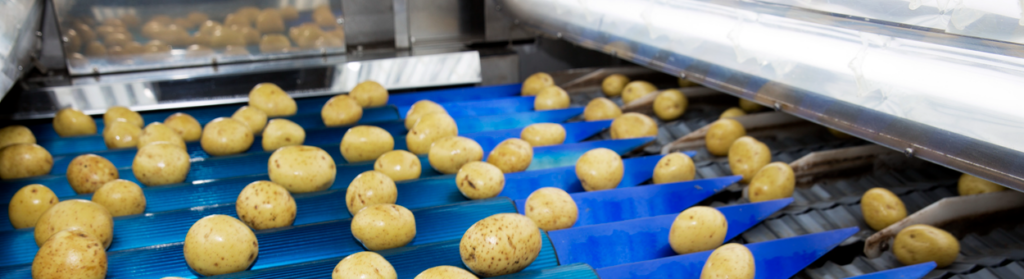
In Cortha’s custom agritech systems, our physical imaging arrays are configured to ensure total coverage. For instance, using multi-camera arrays positioned over rolling conveyor beds allows produce to be rotated and inspected across 100% of its surface area. High-speed area-scan or line-scan cameras capture crisp, high-resolution visual data even as crops move across belts at high velocities.
However, high-grade optical technology alone only answers part of the challenge. A camera can capture a high-resolution image of a mud-coated tuber or an oddly shaped crop, but standard software rules cannot consistently determine whether a surface dark spot is acceptable soil or unacceptable rot.
| Inspection Paradigm | Technology Approach | Handling Organic Variation | Adaptability |
|---|---|---|---|
| Traditional Machine Vision | Rigid RGB colour thresholds, manual geometric rules | High false-reject rates when dirt or skin variations occur | Requires vendor reprogramming for new conditions |
| Cortha AI-Augmented Vision | High-res optics combined with Edge AI & neural networks | Learns natural variations in shape, variety, and soil | On-site retraining and continuous learning capabilities |
The Breakthrough: AI as the Cognitive Engine
Organic produce is inherently non-uniform; no two potatoes, onions, or apples are identical in shape, size, or surface texture. Human inspectors excel because the human brain naturally accounts for natural variations while spotting true anomalies.
By integrating deep learning frameworks and instance segmentation models into the imaging pipeline, Cortha’s software bridges the gap between mechanical speed and human intelligence:
- Instance Segmentation: On crowded conveyor belts, touching produce items are often misidentified by legacy systems as a single, oversized object. Deep neural networks draw individual masks around touching tubers, identifying distinct boundaries and precise centers of gravity for accurate mechanical ejection.
- Contextual Feature Recognition: Rather than relying on simple pixel color counts, AI models analyze pattern structures. The system can differentiate benign skin variations, such as adhering soil, from rejectable conditions like late-stage rot, black scurf, or growth cracks down to a 2mm resolution.
- Deterministic Real-Time Inference: To operate at commercial line speeds (processing up to 30+ tons per hour), image processing must occur locally at the “edge”. By deploying optimized inference engines on industrial GPUs, Cortha systems complete complex defect classification in under 5 milliseconds per object.
Empowering Operators: On-the-Fly Self-Training
A major drawback of legacy sorting equipment is its rigidity. If an unusual crop condition or new defect type appears mid-season, growers traditionally have to wait for external software engineers to retrain and redeploy model files.
Cortha’s architecture includes an intuitive User Training Module directly within the touchscreen interface. When operators spot an unclassified defect on the live inspection feed, they can capture high-resolution frames, annotate the defect area on-screen, and trigger a local model update. This capability puts the power of machine learning directly into the hands of farm managers and packhouse staff, allowing the system to adapt to local crop variations in real time.
Moving Beyond Surface Inspection
While high-resolution RGB optics enhanced by AI already outperform manual sorting in speed and consistency, Cortha continues to advance agricultural inspection capabilities.
By integrating multi-spectral and Short-Wave Infrared (SWIR) imaging, our platforms are expanding beyond visible surface analysis. SWIR wavelengths penetrate produce tissue, allowing AI models to detect invisible sub-surface bruising, internal cavities, dry matter content, and early-stage rot before visible symptoms appear on the skin.
In modern precision agriculture, exceptional camera optics provide the vision, but artificial intelligence provides the understanding. By uniting high-speed optical hardware with trainable, edge-computed neural networks, Cortha transforms complex post-harvest sorting from a labour-intensive bottleneck into an automated, highly accurate, and scalable operation.
