
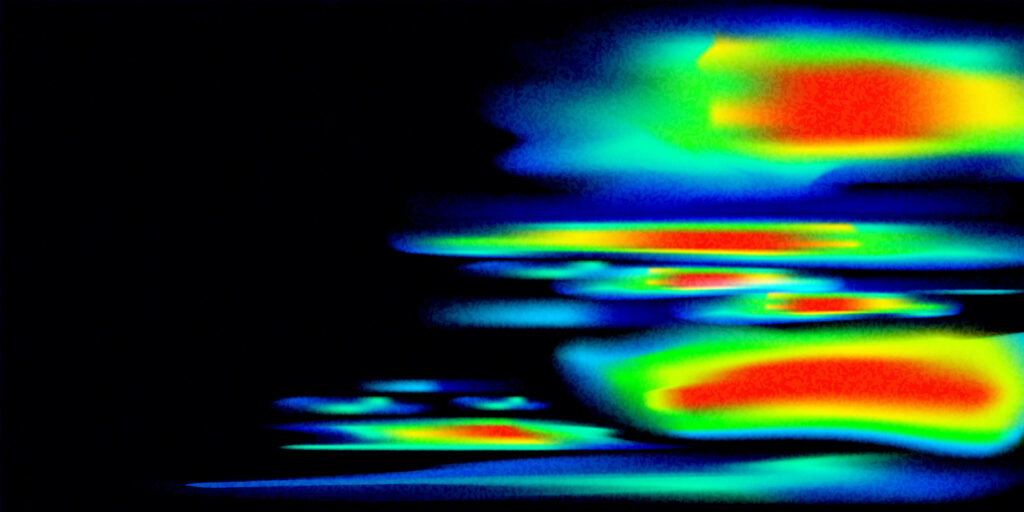
How Spectral Imaging Powers Cortha’s Inspection Systems

Traditional industrial computer vision relies heavily on standard RGB (Red, Green, Blue) surface cameras and standard monochrome linescan units. While effective for verifying dimensions, surface colour, and macro geometrical features, RGB optics operate with significant limitations: they capture only external appearance. Standard optical systems—and even high-density X-ray inspection—fail when attempting to detect sub-surface bruising, internal physiological decay, early-stage disease, or low-density foreign contaminants such as transparent plastic films on wet surfaces.
At Cortha, we overcome these optical limits by integrating Near-Infrared (NIR), Multispectral, and Hyperspectral Imaging (HSI) directly into automated inline inspection and robotic rejection architecture. By measuring how light interacts across continuous bands of the electromagnetic spectrum, our systems evaluate what material an object is made of rather than merely what it looks like.
Technical Overview: The Science of Material Intelligence
Every biological tissue, polymer, and composite material possesses a unique chemical signature dictated by its molecular composition. Advanced spectral imaging exploits how specific molecular bonds—such as carbon-hydrogen, oxygen-hydrogen, and nitrogen-hydrogen—absorb, reflect, and scatter light at distinct wavelengths.
Spectral Regimes and Optical Architectures
Cortha deploys three primary spectral imaging modalities across industrial manufacturing and food processing:
- Near-Infrared (NIR) Imaging (700nmto 1100nm / 750nm to 2500nm:
NIR radiation penetrates beneath the outer cuticle or surface layer of organic targets. It is exceptionally sensitive to local water content, cell wall turgor loss, and sugar accumulation (soluble solids). For instance, overtone absorption around 970nm provides an immediate measure of tissue dehydration, internal bruising, and early rot. - Multispectral Imaging:
Multispectral systems capture discrete, non-contiguous spectral channels (typically 3 to 20 targeted bands). By focusing exclusively on pre-selected wavelengths where a specific defect or chemical contrast is maximized, multispectral hardware delivers high-frame-rate execution with low computational load, ideal for ultra-fast line sorting. - Hyperspectral Imaging (HSI) & Short-Wave Infrared (SWIR):
HSI systems collect unbroken, continuous spectral data across hundreds of narrow contiguous channels. This creates a 3D data structure known as a hypercube—combining two spatial dimensions (X, Y) with a continuous spectral dimension (𝞴) for every pixel. SWIR line-scan cameras (900nm to 2500nm) isolate sharp molecular absorption features characteristic of polymers, allowing instant detection of synthetic contaminants embedded in biological streams.
| Modality | Typical Wavelength Band | Data Output | Primary Physical/Chemical Trigger | Best Industrial Use Case |
|---|---|---|---|---|
| Monochrome / RGB | 400nm to 700nm | 2D Spatial (X, Y), 1–3 Colour Bands | Visual surface reflection & colour contrast | Surface dimension, shape, edge profiling |
| Near-Infrared (NIR) | 700nm to 1100nm | 2D Spatial + High-Speed NIR Bands | Moisture (O-H) overtones, cellular density | Sub-surface bruising, internal turgor loss |
| Multispectral | Discrete bands 400nm to 1000nm | Targeted discrete spectral frames | Specific chemical signatures & surface flaws | High-speed targeted grading, husk penetration |
| Hyperspectral (SWIR) | 900nm to 2500nm | 3D Hypercube (X, Y, 𝞴) | C–H, O–H, N–H vibrational absorption | Foreign object detection (film/FOD), chemical mapping |
Deployment in Action: Cortha Case Studies
1. Intercepting Undetectable Contaminants: Clear Film in Wet Salad Lines
Clear plastic film fragments represent one of the food industry’s most challenging foreign body risks. X-ray inspection systems are blind to thin film due to its lack of density contrast. Standard colour cameras fail because transparent film sitting on wet, glossy leaves reads simply as surface reflection glint.
- The Cortha Solution: We installed a SWIR hyperspectral line-scan system positioned over a belt-to-belt transfer point. While water-dominated leaf tissue and synthetic packaging film appear identical under visible light, polymer film exhibits distinct C–H absorption bands in the SWIR spectrum where leaf tissue does not.
- Implementation: The system normalises every scan line against live dark and white reference channels to compensate for belt moisture and lamp drift. A spatial-spectral machine learning classifier evaluates each line in under 2ms, tracking flagged fragments to trigger targeted mid-fall air-jet ejectors.
- Results: Seeded-fragment detection increased from 32% to 99.1%, while false-reject rates dropped by 87% at full line speed (0.5\text m/s).
2. Sub-Surface Phytosanitary & Disease Inspection in Fresh Produce
Visual grading cannot identify early-stage internal decay or sub-surface insect infestation.
- Asparagus Larval Infestation (Elasmopalpus lignosellus): Internal larval tunneling causes localised vascular disruption, turgor loss, and water depletion in stem tissues. Cortha’s VIS-NIR hyperspectral models analyse physiological changes around the 970nm water absorption band, classifying infested spears with over 97% validation accuracy long before external stem damage appears.
- Pineapple Translucency & Core Rot: Translucency is a internal disorder where inter-cellular spaces fill with liquid, leading to a watery, glassy texture and rapid spoilage. Using non-destructive VIS-NIR spectral mapping, Cortha systems grade internal flesh density and soluble solids (brix) non-destructively, preventing unacceptable fruit from clogging packaging lines.
- Soft Fruit & Root Crops: High-speed NIR linescan systems identify micro-cracks, soft spots, and early fungal infections (such as Botrytis) on delicate strawberries and blueberries, as well as hollow heart and wireworm damage deep inside root vegetables.
3. Continuous Web Inspection: Carbon Fibre & Industrial Materials
Beyond food processing, continuous web inspection of advanced materials like carbon fibre composite sheets requires real-time sub-surface anomaly verification.
- Multi-Sensor Fusion: By pairing high-speed Contact Image Sensors (CIS) or 2D linescan bars with 3D laser line profilers and SWIR spectral cameras, Cortha inspects carbon fibre webs for broken tow, fuzz balls, and physical wrinkles, while simultaneously using spectral data to spot uncured resin accumulation, dry areas, and non-metallic Foreign Object Debris (FOD).
[ High-Speed Substrate / Line ]
               │
               ▼
┌──────────────────────────────┐
│  SWIR / NIR Line-Scan Head   │  ────> Captures continuous spatial-spectral lines
└──────────────┬───────────────┘
               │
               ▼
┌──────────────────────────────┐
│ Live Referencing & Radiance  │  ────> Normalizes lamp drift, ambient temperature,
└──────────────┬───────────────┘        and surface moisture in real-time
               │
               ▼
┌──────────────────────────────┐
│ Spatial-Spectral Classifier  │  ────> Compact ML models (SVM / PLS / Neural Networks)
└──────────────┬───────────────┘        reduce 300+ bands to key discriminant features
               │
               ▼
┌──────────────────────────────┐
│ Low-Latency PLC & Robotics   │  ────> Triggers air-jet reject banks or robotic arms
└──────────────────────────────┘        to remove defects in < 150 ms
By bridging advanced optical physics with rugged industrial automation, Cortha delivers turnkey inspection systems that eliminate recall risks, protect commercial brand equity, and reduce waste across demanding production environments.
