
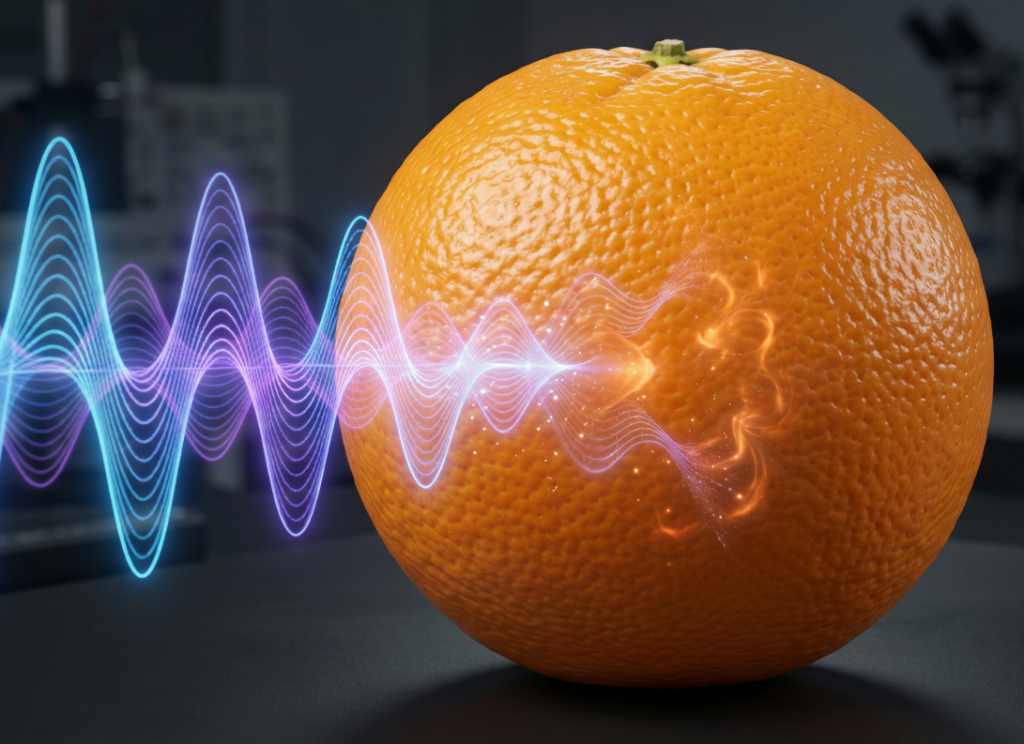
: Non-Invasive Microwave Sensing & Tri-Modal Produce Inspection
Post-harvest quality assurance across global agribusiness is undergoing a fundamental technological shift
While traditional optical inspection—utilising Red-Green-Blue (RGB) and Near-Infrared (NIR) imaging—has successfully automated external defect sorting, deep internal flaws remain a persistent challenge for packhouses. Hidden anomalies such as core rot, internal browning, hollow heart, water-soaking, and translucency often exhibit zero surface symptoms.
To overcome the physical limits of optical light without resorting to costly X-ray setups or heavy Short-Wave Infrared (SWIR) arrays, Cortha has introduced a Tri-Modal Inspection Stack. By fusing low-power microwave dielectric sensing with advanced RGB and NIR optics, Cortha transitions industrial quality control from surface-level visual checks to total internal material intelligence.

The Limits of Traditional Machine Vision
Modern commercial packing lines operate at high throughputs (processing upwards of 30+ tonnes per hour). However, conventional inspection technologies present distinct operational boundaries:
- RGB Surface Optics (400–700 nm): Restricted to the outer cuticle, verifying surface colour, geometry, 3D volume, and external blemishes. They remain blind to internal defects.
- Near-Infrared Optics (700–1100 nm): Penetrate 1 to 5 mm into outer tissue. While highly effective at identifying near-surface moisture loss, skin turgor, and superficial bruising, NIR photons cannot penetrate deep into the core matrix.
- SWIR Hyperspectral & Industrial X-Ray: Capable of deeper analysis but introduce severe commercial drawbacks—SWIR requires heavy GPU computing to process massive 3D hypercubes, while X-ray systems demand lead shielding, high-voltage power supplies, and strict radiation safety compliance.
The Science of Microwave Dielectric Detection
Microwave inspection relies on transmitting low-power radio frequency (RF) electromagnetic waves (typically sweeps between 0.5 GHz and 20 GHz, with dedicated calibration sweeps between 1 and 3 GHz) directly through fruit and vegetable tissue.
Crucially, the microwave energy utilised across these frequency sweeps operates at extremely low power levels—comparable to standard Wi-Fi signals. As a result, the sensing process is entirely safe, induces no dielectric heating, and does not cook or alter the physical integrity of the inspected produce.
Unlike light photons, RF waves pass completely through dense biological material without being scattered by thick rinds or surface cuticles. As the signal propagates, it interacts directly with the dielectric medium of the produce:
Dielectric Permittivity & Signal Dynamics
Biological tissue consists primarily of water, sugars (soluble solids), organic acids, and cellular membranes. The propagation of microwave energy through tissue is governed by its relative complex permittivity:
- Real Permittivity (Storage Factor): Quantifies the tissue’s ability to polarise and store electrical energy in an oscillating RF field. Free water molecules exhibit a very high dielectric constant compared to dry cellular matter. Measuring real permittivity provides an exact profile of internal water distribution and hydration state.
- Imaginary Permittivity (Loss Factor): Measures the dissipation of electrical energy into heat via dipole rotation and ionic conduction. Dissolved sugars, salts, and organic acids directly alter the loss factor, reflecting internal sweetness, ripeness, and cellular breakdown.
Non-Invasive Internal Defect Mechanisms
- Core Rot & Fungal Decay: Fungal pathogens destroy cell wall turgor, releasing bound water into intercellular spaces. This sudden influx of free water triggers distinct localised spikes in dielectric loss and phase delay.
- Internal Translucency & Water-Soaking: Liquid accumulation in intercellular spaces alters complex permittivity, shifting RF transmission parameters across specific microwave frequencies.
- Hollow Heart & Internal Void Mapping: Air gaps inside tubers or root vegetables interrupt dielectric continuity. The sharp permittivity boundary between air and surrounding wet tissue creates sharp reflection and phase signatures.
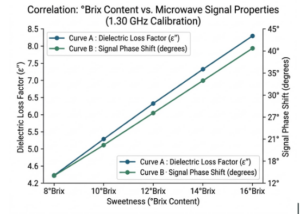
- Brix & Sugar Measurement: Microwave transmission at key calibration frequencies (such as 1.30 GHz) demonstrates a clear, monotonic relationship with juice concentration, enabling precise, non-contact measurement of sugar content across items like pineapples and melons.
The Tri-Modal Sensing Architecture
Cortha’s hardware architecture divides inspection into three distinct structural layers across the product volume:
| Layer | Modality | Spectrum / Wavelength | Penetration Depth | Primary Target & Pathology |
|---|---|---|---|---|
| Layer 1: Surface Envelope | RGB Optics | Visible (400–700 nm) | Surface Cuticle | Exterior colour, 2D/3D morphometrics, shape symmetry, external blemishes |
| Layer 2: Sub-Surface Mantle | NIR Optics | Infrared (700–1100 nm) | Outer Flesh (1–5 mm) | Near-surface moisture, sugar/water overtones (970 nm), skin turgor loss, bruising |
| Layer 3: Deep Core Matrix | Microwave RF Transceivers | Radiofrequency (0.5–20 GHz) | Full Core Penetration | Deep core rot, hollow heart, internal browning, Brix distribution, internal translucency |
Case Study: Inline Citrus Fruit Inspection
To demonstrate the practical application of Cortha’s multi-modal framework, consider an inline system configured specifically for citrus fruit inspection (e.g., oranges and mandarins). Citrus fruits present unique quality assurance challenges: external defects such as rind blemishes, scarring, and mould are visible on the surface, whereas internal issues like granulating flesh, drying out, or internal rot remain completely hidden beneath a thick peel.
The system integrates high-resolution RGB cameras with low-power microwave dielectric sensors to inspect each fruit non-destructively in real time:
- RGB Surface Inspection: High-speed optical sensors capture 360-degree surface imagery to evaluate skin colour, detect surface blemishes, measure diameter, and assess overall shape symmetry.
- Microwave Dielectric Evaluation: RF transceiver sweeps pass through the entire volume of the citrus fruit. By analysing changes in real and imaginary dielectric permittivity, the system maps internal moisture content to identify dried-out segments and measures sugar concentration (Brix) to ensure uniform sweetness across batches.
By combining surface visual metrics with volumetric microwave data, the packing line automatically sorts citrus produce into optimal market streams, e.g., premium fresh export versus domestic processing, without requiring destructive manual sampling or slowing conveyor speeds.
We provide these systems to agricultural machine builders through Ro-Pro, our group agritech company.
To find out more contact Steve Green via sales@ro-pro.com, or call +44 (0)1522 462786.